
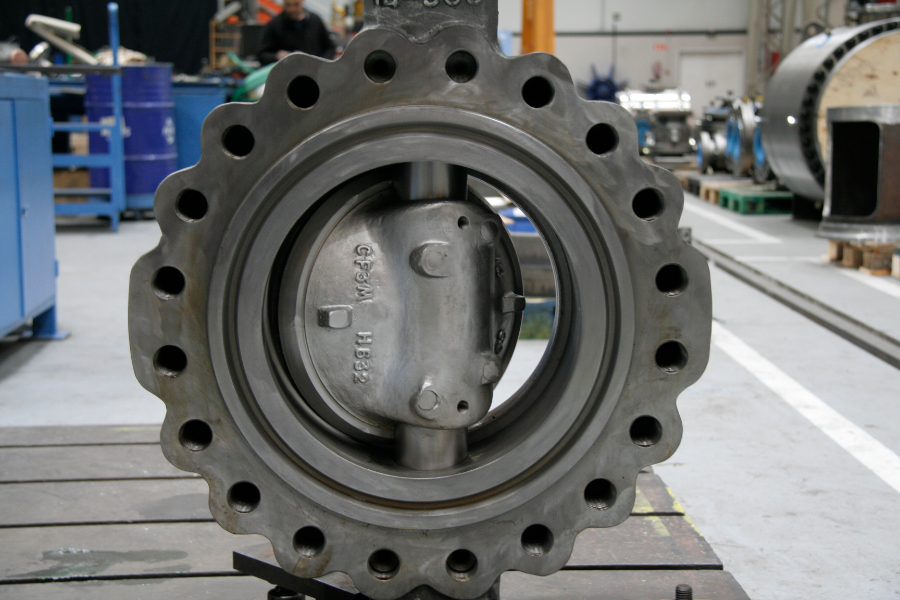
Triple eccentric valves use a carefully engineered geometry to address one of the fundamental challenges in butterfly valve design: achieving effective shut-off while minimising contact between the sealing surfaces during operation. Also known as triple offset butterfly valves, their defining characteristic is the use of three separate eccentricities that determine the relative positions of the shaft, disc, valve centreline and sealing surfaces.
However, the three offsets should not be considered as isolated design features. Together, they determine how the disc approaches and moves away from the seat throughout its rotation. The sealing surfaces disengage as the valve opens and remain separated during most of the travel. They come into contact again as the disc reaches its final closing position. This controlled interaction helps reduce friction and wear while providing the sealing action required for tight shut-off.
What makes a butterfly valve triple eccentric?
The first two eccentricities relate to the position of the shaft. The first offset places the shaft centreline away from the centreline of the sealing surface. As a result, the shaft does not rotate directly through the centre of the sealing interface. The second offset moves the shaft away from the centreline of the pipe and valve. This arrangement helps minimise friction between the seat and sealing ring during operation.
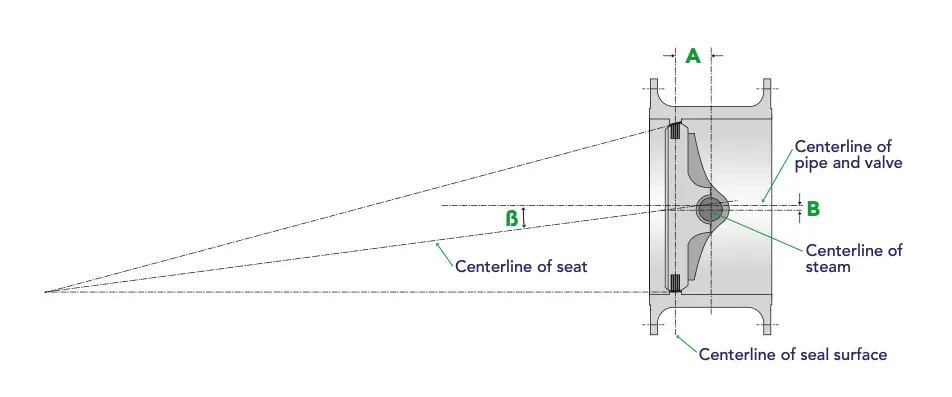
The third eccentricity is different because it relates directly to the geometry of the sealing surfaces. Here, the centreline of the inclined cone formed by the sealing surface diverges from the pipe and valve centreline. This third offset plays a particularly important role during the final part of the closing movement.
Together, the three eccentricities create a distinctive movement. When the valve starts to open, the sealing surfaces disengage instead of continuously rubbing against each other. They remain separated during most of the disc rotation and approach each other again as the valve closes. Therefore, the design concentrates the sealing interaction around the final closing position rather than throughout the entire stroke.
Reducing friction while maintaining tight shut-off
This distinction between movement and final closure explains one of the main advantages of triple eccentric geometry. Continuous sliding contact between sealing surfaces generates friction and can contribute to wear over repeated operating cycles. Separating those surfaces during most of the stroke reduces unnecessary rubbing. At the same time, the design allows them to make the contact required for shut-off when the disc reaches its closed position.
The sealing system works together with this geometry. In our triple eccentric butterfly valves, the disc sealing ring is replaceable. We can supply a laminated stainless-steel sealing ring combined with graphite or PTFE, while full metal-to-metal seating is also available. In the laminated configuration, torque applied during closing compresses the ring to achieve the required sealing action.
This distinction is important. Reducing friction does not mean eliminating contact altogether, since a shut-off valve still requires an effective sealing interface. Instead, the three eccentricities control when and how the sealing surfaces make contact. They avoid unnecessary interaction during most of the stroke while allowing the sealing system to perform its function at closure.
Triple eccentric butterfly valve configurations
We offer our triple eccentric butterfly valves in wafer, lug and double-flanged configurations. Each provides a different installation arrangement while retaining the same triple eccentric operating principle. We design these valves according to API 609 and test them according to API 598.
Our range covers sizes up to 80 inches and ANSI Classes 150 to 900. This allows us to apply the triple eccentric concept across a broad range of valve sizes and pressure classes. The range is suitable for pipelines in chemical plants and power plants, as well as water and heating systems. The final configuration will depend on the requirements of each service, including factors such as body construction and seating arrangement.
The available dimensions also vary according to pressure class and construction. For example, our technical documentation includes wafer, lug and double-flanged configurations for ASME Classes 150 and 300. The Class 600 range also includes these construction alternatives, with dimensions and available sizes defined for each configuration.
Why the third offset changes the sealing movement
Simply listing the three eccentricities does not fully explain why this valve design works. Their real purpose becomes clearer when we look at the movement of the disc in relation to the seat. The first and second offsets establish the rotational axis, while the third defines the inclined sealing geometry. Together, they allow the sealing ring to move away from the seat as the valve opens rather than sliding continuously against it.
The process reverses during closing. As the disc rotates towards its final position, the sealing surfaces approach their designed point of engagement. In our laminated sealing arrangement, the final closing torque provides the ring compression required for sealing. Geometry and sealing therefore perform complementary functions: the eccentric design controls the movement and interaction of the surfaces, while the sealing system provides the final shut-off.
This is also why the third eccentricity is especially relevant. Our technical documentation identifies it as the most critical of the three offsets. Rather than simply changing the position of the disc, it defines the geometry of the sealing interface itself. A relatively subtle change in angle therefore has a significant effect on how the seat and sealing ring interact throughout the operating cycle.
Selecting the right triple eccentric valve
The three offsets define the operating principle, but they are only part of the valve specification. Body configuration, size, pressure class and seating arrangement must also match the requirements of the installation. Our range includes wafer, lug and double-flanged construction, together with laminated and full metal-to-metal seating alternatives.
Understanding the three eccentricities is nevertheless a useful starting point when selecting this type of butterfly valve. They explain one of its most characteristic engineering features: the sealing surfaces do not need to rub continuously throughout the stroke to achieve tight shut-off. Instead, carefully positioned axes and an inclined sealing geometry determine how those surfaces separate, move and finally engage. What may appear to be a small change in the position of a shaft or the angle of a sealing surface ultimately changes the way the valve closes.